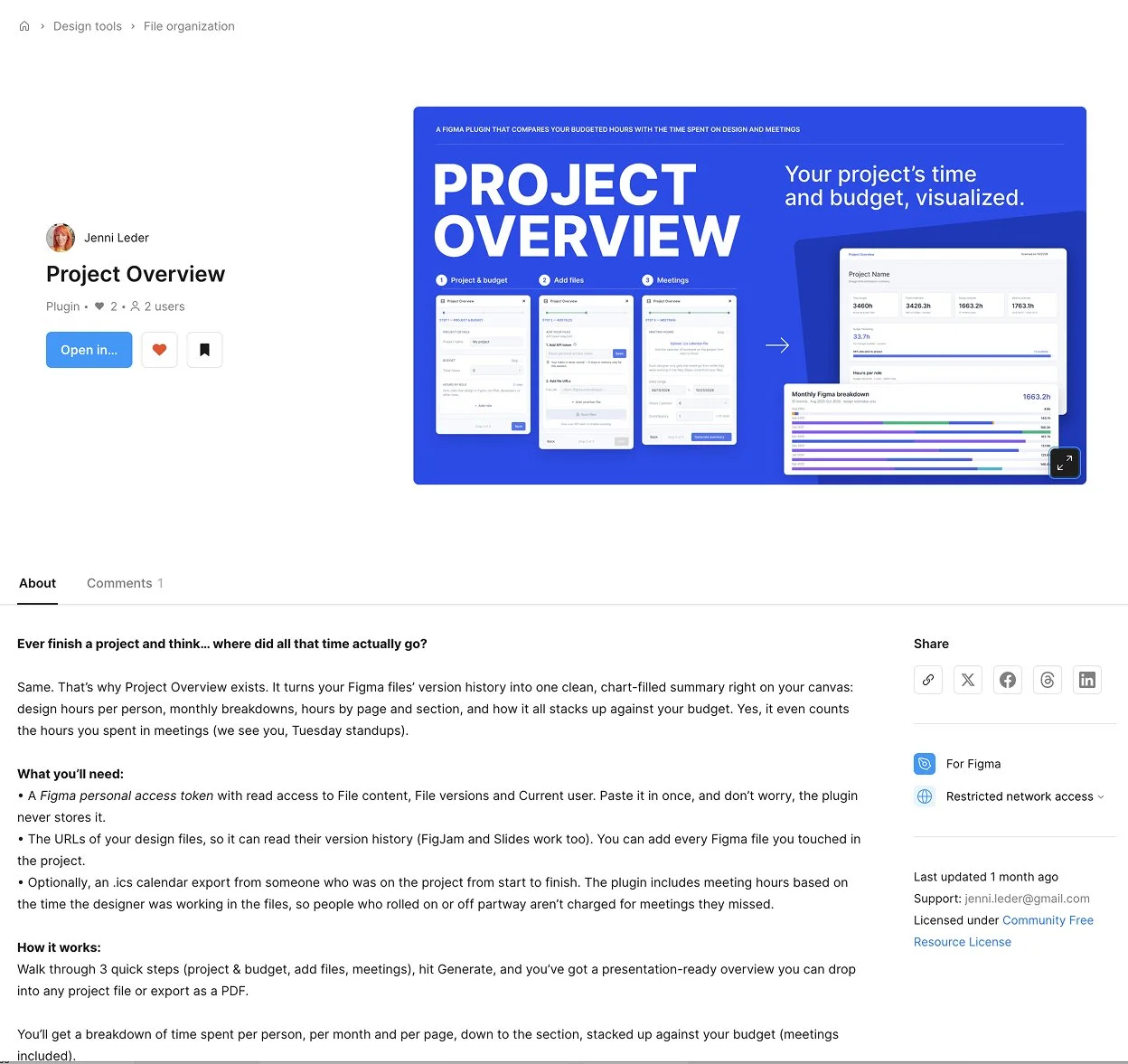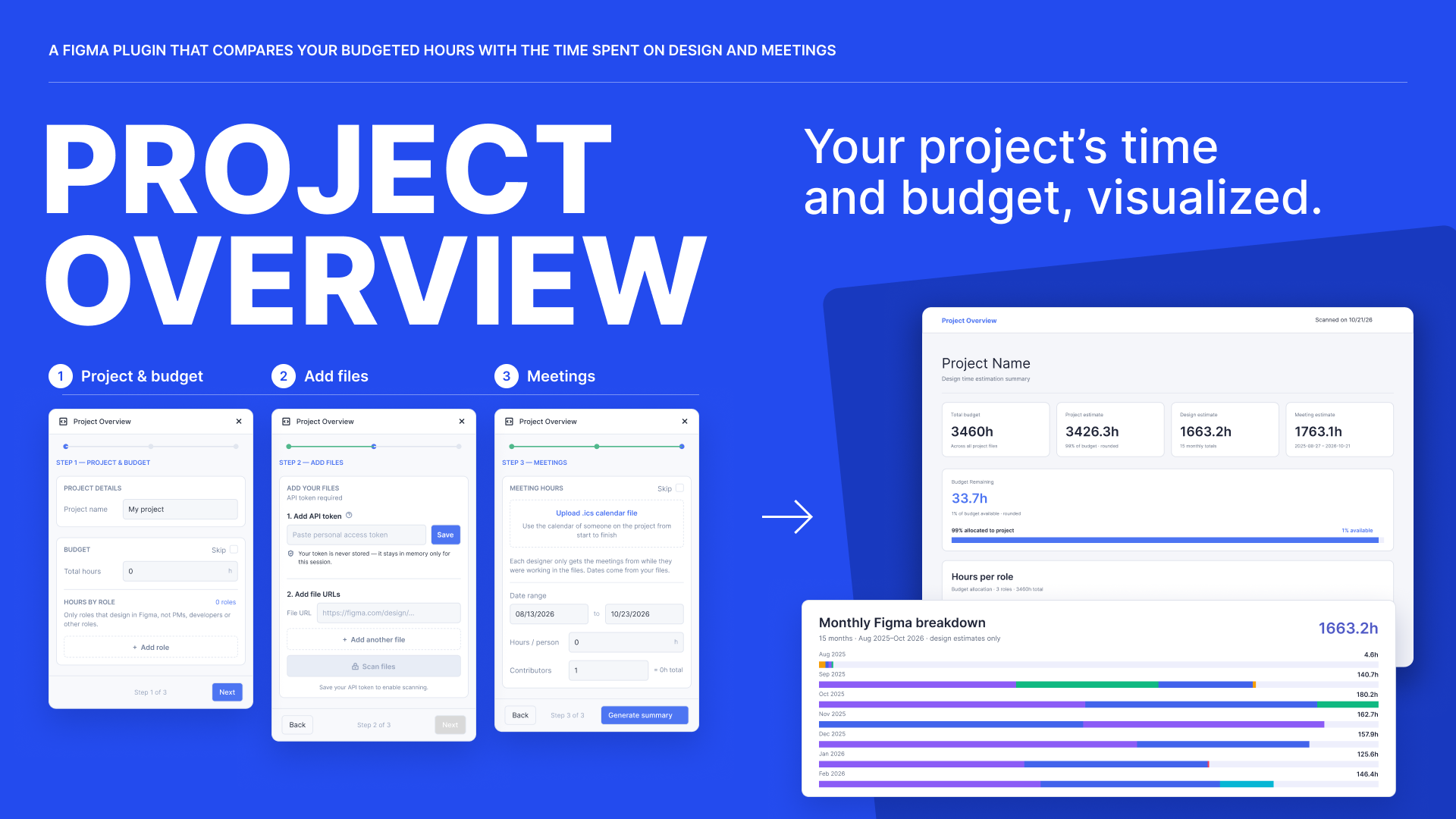
Something I made finally got published in the Figma Community today so I'm pretty excited! It’s a Figma plugin that tracks how much time you spend designing, lets you add time spent in meetings, and compares it all to the original project estimate.
I wanted to know how long things actually take. Not just designing, but all the meetings, feedback, revisions, etc.
This started out as an internal plugin on my work’s Figma instance, I wrote about the process building it as a side quest.
After talking to other designers about this plugin, they really wanted to use it as well. I started down the path of simplifying the UI a bit more, cleaning it up, and tightening up the output. I’m happy with how it’s turned out, I hope it helps you as well!
Why I built this
So as a designer, sometimes it feels like we aren't given enough time to work on a project compared to what was originally estimated. We end up working extra hours, nights, and sometimes weekends just to get things done on time.
I've often felt like the time we actually spend designing is much more than what's accounted for, but I never really had proof beyond loose estimates and feeling burnt out.
So I had an idea for a Figma plugin that tracks how much time you spend designing, lets you add time spent in meetings, and compares it all to the original project estimate.
I wanted to know how long things actually take. Not just designing, but all the meetings, feedback, revisions that add up throughout a project.
A lot of that work is practically invisible when it comes to estimating timelines. We might be given 20 hours to design something, but how much of that time is actually spent designing? And when a project takes longer than expected, is it because the designer worked too slowly, or because the original estimate didn't account for everything involved?
That's what I wanted to make more visible.
Having actual data could help us make better estimates, set more realistic timelines, and give designers something concrete to point to when advocating for the time they need. It's not about proving that we're busy. It's about showing what it really takes to do the work well.
And yes, I used AI to help me code it, but I don't think this idea would have become a reality without it. It was pretty fun being able to build something on my own without having to rely on someone else to make it happen. I love that I can now take a problem I've experienced firsthand and actually build a tool to help solve it, not just for myself, but hopefully for other designers too.